
Audit Report
Report: Financial Intelligence Units – Effective Tools for Combating Corruption If Allowed to Work | CUAC
Civil Union – Transparency International
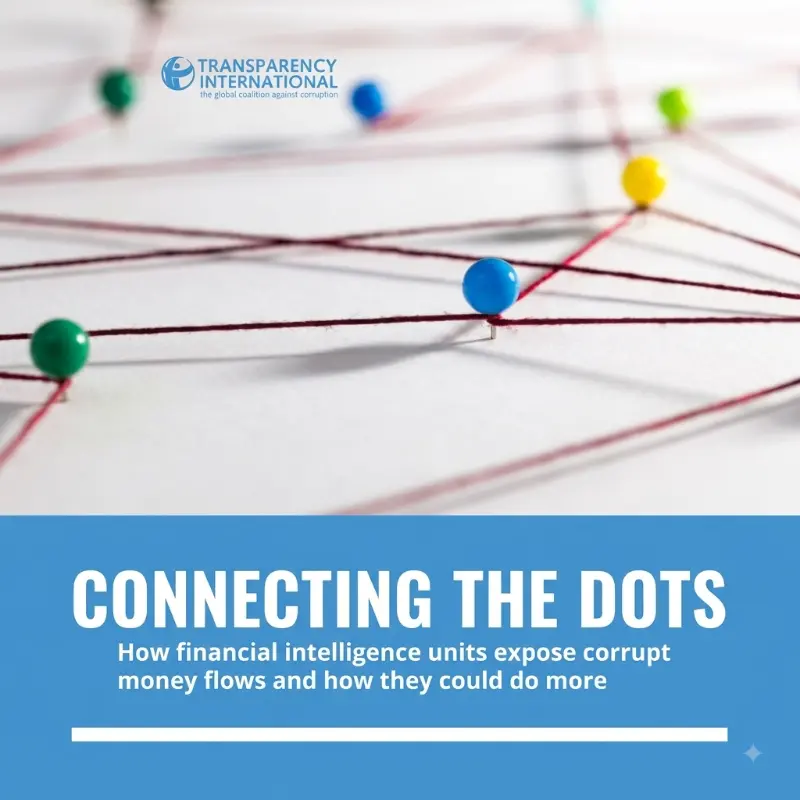
A recent study conducted by Transparency International across 20 countries has revealed that Financial Intelligence Units (FIUs) can play a pivotal role in detecting corruption, tracing illicit financial flows, and supporting the recovery of stolen assets. However, their ability to perform this role remains constrained by gaps related to data access, reporting requirements, legal authority, independence, and available resources.
These units are designed to identify financial connections that may be difficult for other institutions to detect, such as companies that conceal their beneficial owners, luxury properties purchased with funds of unknown origin, consultancy fees that are not supported by any clear business activity, and financial transfers between individuals who appear to have no direct financial relationship.
While these indicators may seem inconclusive when viewed separately, collecting and analyzing them can reveal complex financial networks operating behind corruption and money laundering schemes.
What Are Financial Intelligence Units?
Financial Intelligence Units are public agencies responsible for receiving and analyzing suspicious transaction reports submitted by banks and other reporting entities. They then share relevant financial information with law enforcement agencies, prosecutors, regulatory authorities, and their counterparts in other countries.
These units occupy a central position within anti-money laundering systems because they can connect fragmented pieces of information that no single financial institution or government agency can fully access or interpret on its own.
However, the effectiveness of these units depends directly on the quality of the information they can access, their analytical capabilities, the legal powers granted to them, and the willingness of competent authorities to act on the intelligence they provide.
How Do Financial Intelligence Units Detect Corruption?
At their best, Financial Intelligence Units can transform scattered financial indicators into a clear picture of a potential corruption scheme.
Their role is not to replace investigators or prosecutors. Instead, they identify suspicious patterns, connect financial information, and provide intelligence that can help competent authorities initiate investigations and take legal action.
The Chilean Experience
In Chile, the Financial Analysis Unit (Unidad de Análisis Financiero) contributed to uncovering a corruption case involving irregular spending by a national police officer.
The investigation began with a suspicious transaction report, followed by a broader financial analysis that helped expose the embezzlement of public funds and a money laundering network. The case ultimately resulted in 116 convictions between 2019 and 2022.
The French Experience
In France, the French Financial Intelligence Unit (Tracfin) helped uncover a scheme involving concealed payments to a mayor that had been disguised as funding for local sports organizations.
Although the transactions initially appeared legitimate, linking bank accounts, payment channels, and beneficiaries revealed a far more complex financial pattern. This contributed to criminal proceedings and subsequent judicial convictions.
These cases demonstrate how financial information, when properly analyzed and connected, can be transformed from isolated transactions into intelligence that helps authorities uncover corruption networks.
Gaps That Limit the Effectiveness of Financial Intelligence Units
According to Transparency International, several Financial Intelligence Units still lack direct and sufficient access to the data necessary for tracing financial flows, including information on company ownership, tax records, and law enforcement databases.
The study found that 14 out of 20 countries provide direct access to beneficial ownership information, while operational beneficial ownership registers are absent in four countries: Chile, China, Italy, and Mexico.
The study also found that only eight units have direct access to tax records, while 11 units have direct access to law enforcement databases.
Information Alone Is Not Enough
The study emphasizes that the value of financial intelligence does not end with collecting and analyzing information. Its effectiveness ultimately depends on what happens after that information is shared with the relevant authorities.
Information requested by investigators as part of ongoing cases is more likely to be used, while intelligence proactively submitted by Financial Intelligence Units does not always receive the same level of attention or follow-up.
This represents a significant challenge because proactive intelligence can help uncover new corruption cases before they expand or before those involved have the opportunity to transfer and conceal assets.
The Need for Greater Authority and Independence
Transparency International stresses that Financial Intelligence Units require clear legal powers that enable them to act quickly when suspicious transactions are identified, while also safeguarding their operational independence from political and institutional pressures.
These units also require adequate human and technological resources to manage the growing volume of financial data and transactions, develop analytical tools, and strengthen cooperation with law enforcement agencies, regulatory authorities, and their international counterparts.
The study concludes that Financial Intelligence Units can become one of the most effective tools for combating corruption and money laundering because of their ability to connect fragmented financial information and identify the pathways used by illicit funds.
However, the success of these units depends not merely on their existence, but on their ability to access data, exercise adequate legal authority, maintain operational independence, secure sufficient resources, and establish effective cooperation with investigative bodies, prosecutors, and judicial institutions.
Transparency International concludes that governments must provide these essential conditions to enable Financial Intelligence Units to move beyond simply receiving and analyzing information and toward playing a more effective role in uncovering corruption, disrupting illicit financial flows, recovering stolen assets, and holding beneficiaries accountable.
Read full coverage & interactive reports on our official platform
Open Full Interactive Platform →